Showing posts with label Egypt life. Show all posts

Monday, July 14, 2008

Some of My Favourite Photos


If you look through this blog, you will see that I took a lot of photos during my time in the Arab world. Most of them are straightforward record shots but occasionally I managed one that I am actually quite proud of.

Here's a selection of some of my favourite photos from elsewhere in this blog.


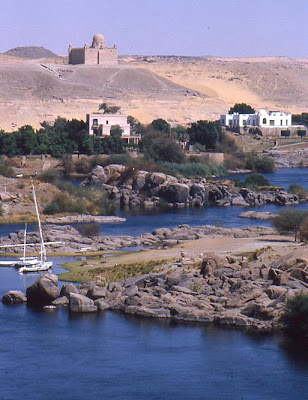
Mausoleum and Camel


I was taking a telephoto picture of the Aga Khan Mausoleum in Aswan, Egypt, when I noticed a movement on a nearby hill. A man on a camel! He paused just long enough for me to change to a shorter lens and fit both him and the mausoleum into my shot.
.

Tuareg Dancer
.

On one of our visits to the oasis town of Gahames in Libya, we were invited to a night-time celebration in the old slave market. This photo captures at least a little of the magical atmosphere of that night and of Ghadames.
.

Dog on a Beach


In Libya, we spent many happy Fridays lounging on Pigeon Island beach, east of Tripoli. Our dog, Dopey, loved the beach as much as we did.


The Treasury
.

At Petra, Jordan, you enter the ancient city through a narrow canyon whose walls are so high that they almost block out the light. Then, just when your eyes have adjusted to the semi-darkness, you turn a corner and there is the Treasury tomb.


Roman Doorway
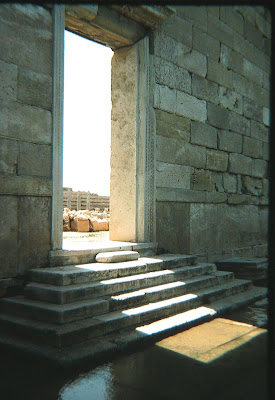

The remains of the Severan forum at Leptis Magna, Libya, are so huge that they are difficult to do justice to in photographs. I think this shot of one of the forum's doorways gives a good impression of the ruins' size.


Horse and Turkey


Egypt is a chaotic country, where beauty often exists side by side with filth and poverty. I took this photo in the village near the Sphinx in 1970.
.

Inb Tulun Mosque

The Ibn Tulun Mosque in Cairo is one of the most beautiful buildings in North Africa. This photo shows how well the mosque reconciles simplicity and elegance.

Sunday, July 13, 2008

The River Nile


The Nile is Egypt. This is true to a great extent today and it was even more true in ancient times. Without the Nile, Egypt would have been an insignificant country people by nomadic tribesmen and a few villages along its coasts and in scattered oases. It was the Nile which allowed Egypt to develop agriculture to the point where it could support a large population. It was the Nile, too, which enabled the ancient Egyptians to establish an empire by making it possible for them to engage in overseas trade.

The Nile at Luxor

The Nile at Aswan


Sunset over the Nile


In ancient times, the river was the quickest and easy way to travel between Upper and Lower Egypt, and it is still a significant thoroughfare for the transportation of goods within the country.


The graceful felucca is still a common sight on the river


Three feluccas at Aswan

A felucca boatman near Aswan


When you travel up or down the Nile, you cannot help be struck by the lushness of the vegetation on both sides of the river. And by the way the river has fostered human life along its banks for thousands of years.


However, you are also frequently reminded of the fact that most of Egypt is desert, and that the desert is constantly trying to take over the fields and farms which line the river.


Monday, June 16, 2008

Sphinx

In prosperous countries, life tends to be fast and change comes quickly. In Egypt, the pace of life is slow and change comes extremely slowly, except in the cities of Cairo and Alexandria.

The pictures below were taken in the village near the Sphinx in 1970. If you visited Egypt today, you would see identical scenes in most villages.


A lot of time is spent sitting in or outside cafes


Animals share the streets with people


Here two goats mingle with shoppers


One way to bring home bread from the baker's is on your head