Monday, July 14, 2008

Some of My Favourite Photos


If you look through this blog, you will see that I took a lot of photos during my time in the Arab world. Most of them are straightforward record shots but occasionally I managed one that I am actually quite proud of.

Here's a selection of some of my favourite photos from elsewhere in this blog.


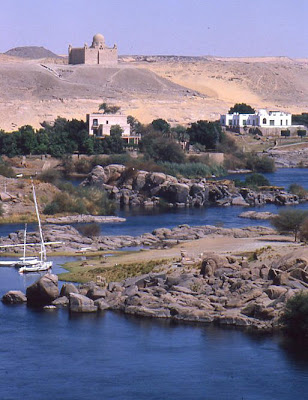
Mausoleum and Camel


I was taking a telephoto picture of the Aga Khan Mausoleum in Aswan, Egypt, when I noticed a movement on a nearby hill. A man on a camel! He paused just long enough for me to change to a shorter lens and fit both him and the mausoleum into my shot.
.

Tuareg Dancer
.

On one of our visits to the oasis town of Gahames in Libya, we were invited to a night-time celebration in the old slave market. This photo captures at least a little of the magical atmosphere of that night and of Ghadames.
.

Dog on a Beach


In Libya, we spent many happy Fridays lounging on Pigeon Island beach, east of Tripoli. Our dog, Dopey, loved the beach as much as we did.


The Treasury
.

At Petra, Jordan, you enter the ancient city through a narrow canyon whose walls are so high that they almost block out the light. Then, just when your eyes have adjusted to the semi-darkness, you turn a corner and there is the Treasury tomb.


Roman Doorway
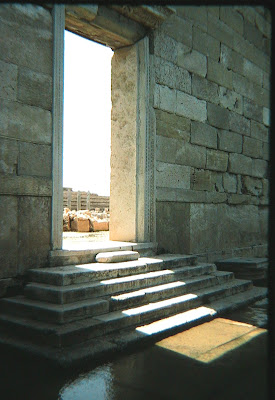

The remains of the Severan forum at Leptis Magna, Libya, are so huge that they are difficult to do justice to in photographs. I think this shot of one of the forum's doorways gives a good impression of the ruins' size.


Horse and Turkey


Egypt is a chaotic country, where beauty often exists side by side with filth and poverty. I took this photo in the village near the Sphinx in 1970.
.

Inb Tulun Mosque

The Ibn Tulun Mosque in Cairo is one of the most beautiful buildings in North Africa. This photo shows how well the mosque reconciles simplicity and elegance.

Sunday, July 13, 2008

The River Nile


The Nile is Egypt. This is true to a great extent today and it was even more true in ancient times. Without the Nile, Egypt would have been an insignificant country people by nomadic tribesmen and a few villages along its coasts and in scattered oases. It was the Nile which allowed Egypt to develop agriculture to the point where it could support a large population. It was the Nile, too, which enabled the ancient Egyptians to establish an empire by making it possible for them to engage in overseas trade.

The Nile at Luxor

The Nile at Aswan


Sunset over the Nile


In ancient times, the river was the quickest and easy way to travel between Upper and Lower Egypt, and it is still a significant thoroughfare for the transportation of goods within the country.


The graceful felucca is still a common sight on the river


Three feluccas at Aswan

A felucca boatman near Aswan


When you travel up or down the Nile, you cannot help be struck by the lushness of the vegetation on both sides of the river. And by the way the river has fostered human life along its banks for thousands of years.


However, you are also frequently reminded of the fact that most of Egypt is desert, and that the desert is constantly trying to take over the fields and farms which line the river.


Thursday, July 10, 2008

Roman Volubilis, Morocco

While on a business trip to Morocco in 1980, my hosts took me to see the Roman city of Volubilis, which is situated between Rabat and Fez.

Originally founded by the Carthaginians in the 3rd Century BC, the city was incorporated into the Roman Empire in about 40 AD. It became the administrative capital of the province of Mauretania Tingitana and grew rich through the export of olive oil, grain and wild animals.


The main public buildings

Although much of the city was destroyed by an earthquake in the 4th Century AD, it was not abandoned until the Arab invasions in the late 7th Century. The remaining buildings were destroyed by the great Lisbon earthquake of 1755. Archaeological excavations began in the early 1900s and several major buildings have since been restored.

These days, the site attracts large numbers of visitors, drawn mainly by its imposing public buildings and by the mosaic floors contained in several mansions.

The Public Buildings

The main public buildings are a triumphal arch, a basilica and a capitol, all built under the Emperor Caracalla in the early 3rd Century AD.


The triumphal arch was originally topped by a bronze chariot


The basilica

Monumental arches in the basilica wall

The steps and columns of the capitol


Water was supplied by an aqueduct , which ran along the side of the main street.


Remains of the aqueduct


As everywhere in the Roman Empire, the public baths were heated by hot air channelled under the floors and behind the walls.


The underfloor heating system


Private Houses and Mosaics

The city's streets are lined with the mansions of wealthy landowners and merchants, and many of these mansions still contain fine examples of mosaic floors.


Several of the mosaics show scenes from mythology.


Others show animals of the types exported to be displayed - and killed - in Roman arenas.


Others have more prosaic subjects, such as local hunting trips.


Some are comparatively crude and less colourful.


Olive Oil Factories

Throughout the city there are remains of factories where olive oil was produced.

The photo below shows the round stone plate on which baskets of olive mash were placed and then crushed by a heavy stone block lifted and lowered by a pulley system.


The oil ran into the channel around the stone plate and through a groove into a square pit (centre left in the photo). Water was poured into the pit and then the oil was scooped off the surface into earthenware jugs ("amphorae").


The slots in the foreground held the pulley supports

This factory used a square pressing plate (bottom right)

Note:
As is often the case with ancient ruins, some of the smaller features are among the most interesting ones. At Volubilis my eye was caught by this simple yet beautiful drain cover in one of the streets.


Friday, July 4, 2008

Underground Houses

Most of Libya is very hot for much of the year and summers away from the coast can be unbearable. One solution that some inhabitants found was to build their houses underground, where they would be insulated from the heat.

We visited a group of such underground houses near Tarhuna.

Looking down into an underground house

Each house has several rooms grouped around a central open courtyard.

You enter the house via a large doorway and a sloping ramp.


Several years ago, the inhabitants were moved into more conventional houses provided by the government. However, the people still move into their old houses during the summer, when the underground dwellings are much cooler than the modern homes.

Thursday, July 3, 2008

Colossi

On my first visit to Egypt, in 1970, one of the sites that impressed me the most was that of the Colossi of Memnon, two enormous statues located on the west bank of the Nile close to the Valley of the Kings. These 60-foot tall statues represent the Pharaoh Amenhotep III and originally flanked the entrance to his mortuary temple, of which little now remains.

The Colossi of Memnon

Note:
In ancient times, one of the statues used to make a strange moaning noise when the wind blew through cracks in it. However, this noise stopped after the Roman emperor Septimius Severus repaired the statues in 199 AD.

Wednesday, July 2, 2008

The Oasis of Gahames

During our time in Libya, our favorite place to visit was Ghadames, a small town in an oasis several hundred miles southwest of Tripoli. Nowhere else in Libya was so calm and beautiful, and the warm hospitality that we always received from the mainly Tuareg inhabitants made every visit there a delight.

The houses in Ghadames are built of mud and the roofs have pointed corners, supposedly to stop the devil from sitting on them.


The insides of the houses are painted in elaborate patterns with a vegetable dye, while the walls are hung with a variety of brass pots and colorful baskets.


When we were there, people kept the old wedding tradition by which the groom provided the house while the bride was responsible for decorating its interior.


As elsewhere in Libya, the women of the household spend most of their time on the rooftop, where they cook, chat with friends and even receive visits by traveling salesmen.


Unlike in the rest of the country, Tuareg women do not usually cover their faces and they work in the fields. Within the Tuareg culture, it is the men who keep their faces covered, even when eating.


Unfortunately, the nature of Ghadames has totally changed since we last visited. A large military garrison was established there in the late 1970s and all of the people moved out of the old houses into new ones in 1986.

Notes:

The Tuareg are known as "the blue men," because the dye from their robes and turbans stains their faces. They were much feared by other tribes because they traditionally did not work but made their living mainly by robbing travelers (and herding camels).

Tuesday, July 1, 2008

A Very Bad Day for Sheep

.
Eid el Adha is a Muslim holiday that commemorates Abraham's decision to sacrifice a sheep in place of his son Isaac. It is marked by the killing and eating of sheep. On this one day, over 250,000,000 sheep are killed throughout the Muslim world. (Large families sometimes kill and eat a camel instead of a sheep.)

It is traditional to give a quarter of the sheep to the poor, to eat a quarter on the day, and to preserve the rest for eating later.

People buy their sheep weeks in advance and fatten them up. You will often see children taking their sheep for walks around their neighbourhoods.

Ali Gibril's family in Tripoli always celebrated Eid al Adha in the traditional manner.


Two of Ali and Fatma's children taking care of the sheep in the days leading up to the holiday

Ali cutting the sheep's throat

Note: Sheep seem to accept their fate and die quickly and quietly. Killing a camel is a much noisier, more difficult and more upsetting matter.


The children watch as the sheep bleeds to death

Ali cuts a nick in the leg and blows into it to separate the fleece from the carcass

Two of Ali's sons dress the carcass

Strips of the meat are hung on clotheslines to dry

.

Note: In Libya the dried meat is put into pots of olive oil and may be left to soak for several months before being taken out and used in cooking.